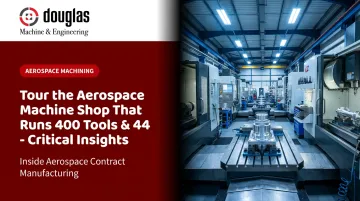
This article is a guided virtual tour of what that environment looks like, combined with the critical insights procurement managers, engineers, and program leads need when evaluating a precision manufacturing partner.
The stakes are real. Choosing the wrong machine shop for aerospace work doesn't just cause delays — it creates traceability gaps, compliance failures, and scrapped parts that cost far more to fix than to prevent. What separates a capable shop from a truly qualified one comes down to systems, certifications, and how the shop manages your program — not just how many machines it has.
Key Takeaways
- 400+ active tools indicate a shop built for diverse geometries and materials — not a single-job operation
- AS9100D and ISO 9001:2015 certifications signal the quality discipline aerospace programs demand
- One-stop shops (design through delivery, one roof) cut supplier handoffs and reduce program risk
- Top aerospace shops own the full chain: program management, supply coordination, and part-to-part traceability
- Asking due-diligence questions before awarding work prevents costly mid-program supplier swaps
The Scale of the Shop: What 400 Tools & 44 Machines Actually Tell You
Raw machine count is a capacity signal, not a performance guarantee. Paired with the right operating metrics, though, scale reveals exactly how a shop handles complexity under pressure.
What a 400-Tool Library Signals
A shop maintaining 400 active cutting tools isn't stocking a general inventory — it's handling diverse part geometries, materials, and tolerances across multiple programs simultaneously. That kind of variety requires systematic tool management: preset tooling systems, documented tool life tracking, and organized tool libraries that operators can access without hunting.
The cost of poor tool discipline is measurable. Research published by Aerospace Manufacturing and Design, sourced from Sandvik Coromant, found that operators in typical workshops spend 20% of their time searching for tools, and 15% of jobs are rescheduled or delayed because the correct tools can't be located.
At 400 tools, that problem compounds fast without disciplined management. NIST research also confirms that uncontrolled tool wear directly degrades dimensional accuracy and surface finish — the two things aerospace buyers can least afford to sacrifice.
What 44 CNC Machines Enable
Forty-four machines on a production floor means multiple part families run simultaneously without one program bottlenecking another. A shop with that footprint can dedicate machines to specific programs during peak demand, absorb new orders without disrupting active production runs, and cut queue time for urgent aerospace requirements.
DM&E (Douglas Machine & Engineering) recently expanded this capacity with the grand opening of its new CNC Production Shop — an investment that adds throughput for high-volume production runs, not just floor space. The shop is certified under both AS9100D and ISO 9001:2015, meaning the production system behind those machines is built to aerospace quality standards.
Why Scale Matters for Tight-Tolerance Aerospace Programs
With 44 machines available, complex aerospace parts requiring multiple setups don't create scheduling collisions. DM&E's documented tolerance capability — ranging from ±0.005" to ±0.0005" — demands that kind of capacity buffer. Material certifications must follow each part through every operation, and a constrained floor simply can't accommodate that traceability without compressing delivery schedules.
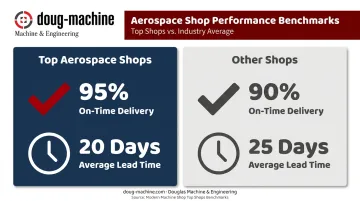
Modern Machine Shop's Top Shops benchmarks show top-performing shops achieving 95% on-time delivery versus 90% for other shops, and 20-day average lead times versus 25 days. Scale supports those numbers when it's paired with the right operating discipline.
A Walk Through the CNC Production Floor
Machining Centers and Multi-Axis Capability
When evaluating a CNC production floor, machine age and condition matter — but axis capability matters more for complex aerospace geometry. The progression from 3-axis to 4-axis to 5-axis machining isn't just a spec upgrade; it directly affects part quality.
Five-axis capability eliminates continuous refixturing for complex geometry. According to Aerospace Manufacturing and Design, some aerospace machining operations span 4 to 5 days for a single part, and reducing off-part motion through 5-axis processing can save up to 12 hours of lost time per part. More setups mean more opportunities for alignment error and tolerance stack-up — the kind of accumulating variance that causes parts to fail inspection at the end of a long production run.
DM&E's CNC mills, lathes, and fabrication equipment handle components up to 20,000 lbs, with CAD/CAM programming through PTC Creo, CATIA v5, and FeatureCAM.
Materials and Process Flow
A typical aerospace part's production journey at a qualified shop looks like this:
- Raw material receiving — material certifications verified before anything moves to the floor
- Programming review — CAM program confirmed against print requirements and tolerances
- First-article inspection (FAI) — per AS9102, documented before production run begins
- Production run — in-process inspection at defined intervals, not just at the end
- Final inspection — dimensional verification on calibrated gauges and granite surface plates
- Shipment with documentation — material certs, FAI report, and inspection records ship with the part
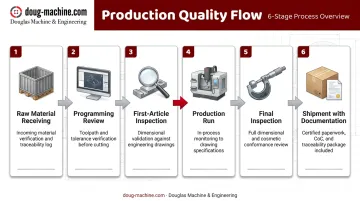
Each handoff is a quality gate. DM&E supports this process with CMM analysis via Exact Metrology, certified granite tables, and comprehensive FAI reporting aligned to AS9102 requirements.
That process only holds up when tooling and materials are matched correctly. Aerospace work spans aluminum alloys (airframes, brackets), stainless steel (fittings, fasteners), and titanium (structural and high-heat applications) — each requiring specific tooling, speeds, and feeds. A 400-tool library isn't a showpiece; it's what makes switching between those material families without delay actually possible.
Welding and Secondary Operations
AWS certified welders on staff means structural and precision weld work stays in-house. Outsourcing welding introduces a new supplier relationship, a new quality receipt inspection, and a potential traceability gap — all of which add lead time and risk to a tight program schedule.
DM&E's AWS certified welding capability supports structural fabrications up to 20 tons, integrated into the same production workflow as its CNC machining operations.
Quality Systems in Action: AS9100D & ISO 9001:2015
What These Certifications Actually Require
AS9100D is the quality management standard for aviation, space, and defense. It builds on ISO 9001:2015 and adds aerospace-specific requirements:
- Risk management — identifying and controlling risks before they become nonconformances
- Configuration management — ensuring parts conform to the correct revision of the drawing
- Key characteristics — identifying features where variation most affects fit, form, or function
- First-article inspection — formal validation of a new or changed production process before full production
ISO 9001:2015 governs the broader quality management system: supplier qualification, calibration of measuring equipment, nonconformance handling, and corrective action. For aerospace buyers, it establishes the baseline discipline that makes AS9100D requirements meaningful in practice.
What Certification Looks Like Day-to-Day
Walk the floor of a certified shop and you should see:
- Documented work instructions at every operator station
- Calibration stickers with current dates on all gauging
- Lot traceability records accompanying every part
- A formal nonconforming material process — written, not improvised
Each of these is a control mechanism — the reason aerospace customers can trust delivered parts without auditing every job themselves.
DM&E's Certification Credentials
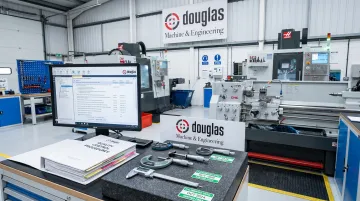
DM&E holds both AS9100D and ISO 9001:2015 certifications, with certification activity documented through December 2024. Beyond those, the company carries several government registrations that matter for defense and aerospace contracting:
- JCP approval — authorizes access to unclassified military and space technical data via DD Form 2345
- SAM approval — required for federal contract award under FAR Subpart 4.11
- CAGE Code 87BF4 — the identifier used in government procurement systems
For buyers in defense or government-adjacent aerospace, DM&E is already vetted. That eliminates a qualification step that can otherwise add weeks to a new supplier onboarding process.
The One-Stop Aerospace Manufacturing Advantage
The Hidden Cost of Vendor Fragmentation
Every supplier handoff in an aerospace program introduces risk:
- A new purchase order and receiving inspection
- A new quality system to qualify and monitor
- A potential traceability gap between operations
- Additional lead time at every transition point
The Deloitte 2026 Aerospace & Defense Outlook notes that supply chain fragility affects delivery credibility, not just cost — and that strain across the supply chain is expected to intensify. Consolidating operations reduces exposure to that fragility.
How DM&E's Model Reduces Handoffs
DM&E operates as a genuine one-stop shop with in-house:
- Design and engineering (PTC Creo, CATIA v5, AutoCAD)
- CNC machining (mills, lathes, precision fabrication to aerospace tolerances)
- AWS certified welding (structural fabrications to 20 tons)
- Project management (coordinating sub-suppliers for heat treat, plating, coating, and CMM inspection)
What might otherwise require four or five vendor relationships and purchase orders consolidates into one. Quality control stays in a single set of hands throughout the program.
The Project Management Dimension
Aerospace programs rarely execute exactly as planned. Material lead times shift, engineering changes happen, and inspection findings need disposition. Each of those moments is where programs slip — or where a capable shop holds the schedule together.
A shop that actively manages your program — coordinating sub-suppliers, flagging schedule impacts before they become crises, processing changes through documented change control — keeps quality and accountability in one place.
DM&E's model includes program management as a deliverable, not an afterthought. For buyers managing tight schedules across multiple suppliers, that distinction directly reduces schedule risk and total program cost.
Key Questions to Ask Before Choosing an Aerospace Machine Shop
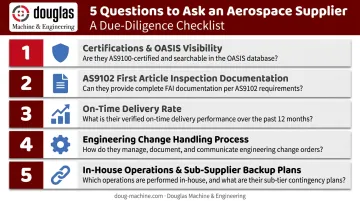
Before awarding significant work, ask these five questions:
- What certifications do you hold, and are you visible in the IAQG OASIS database? AS9100D certification should be verifiable in OASIS — not just claimed on a website.
- Can you provide AS9102 first-article inspection documentation? FAI is a baseline requirement for aerospace supply chain entry at all levels.
- What is your on-time delivery rate for the past 12 months? Top shops benchmark at 95% OTD. Anything below 90% warrants explanation.
- How do you handle engineering changes mid-program? Look for a documented change control process, not an informal response that relies on tribal knowledge rather than written procedures.
- Which operations are performed in-house, and what is your backup plan for single-source sub-suppliers? Concentration risk is real, particularly for specialty processes your shop depends on external vendors to complete.
Documentation answers most of these questions on paper. But paper only tells part of the story.
Why a Shop Visit Still Matters
No certificate replaces a floor walk. Observing cleanliness, machine condition, calibration stations, and how operators interact with travelers and work instructions tells you more about a shop's actual quality culture than any document review.
Red flags to watch for:
- Gauges without current calibration dates
- No documented nonconformance process
- Inability to produce a material cert on request
- No formal first-article process or FAI records
Frequently Asked Questions
How much does a CNC machine shop charge per hour?
Rates vary based on machine complexity, geographic location, material requirements, and compliance costs. AS9100D-certified shops typically carry a premium over general job shops, but that premium is often offset by lower rework costs, faster qualification, and reduced compliance risk across a program.
What does it take to become an aerospace-certified machine shop?
Achieving AS9100D requires implementing a full aerospace quality management system, passing Stage 1 and Stage 2 audits by an accredited registrar, resolving all nonconformities, and maintaining certification through ongoing surveillance audits. The process typically takes 12-24 months for a shop building a QMS from scratch.
What is CNC in aerospace?
CNC (Computer Numerical Control) in aerospace refers to machine tools producing precision components from metals and composites to the tight tolerances required for flight-critical and structural applications. Manual machining cannot hold those tolerances consistently across a production run.
What is AS9100D certification and why does it matter?
AS9100D is the internationally recognized quality management standard for aerospace, defense, and space manufacturing. It requires rigorous control of processes, traceability, risk management, and first-article inspection — giving buyers confidence that parts will meet specification consistently across every production run.
What materials do aerospace machine shops typically work with?
The most common aerospace materials are aluminum alloys, titanium, stainless steel, and specialty composites. Each requires specific tooling, speeds, and feeds, which is why a well-managed tool library is a functional necessity at aerospace-scale production.
How do I evaluate whether an aerospace machine shop can handle my program?
Start by verifying AS9100D certification in OASIS and requesting AS9102 FAI documentation with sample inspection reports. Then confirm which operations are in-house versus outsourced, ask for OTD performance data, and assess the shop's project management and communication processes before awarding work.