What is machine tending in robotics?
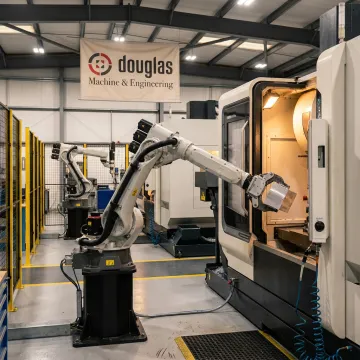
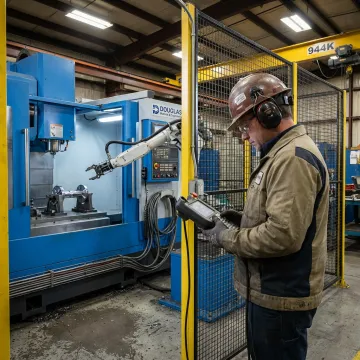
Machine tending in robotics uses an industrial robot to load, unload, position, or transfer parts at equipment such as CNC mills, lathes, presses, or other production machines. A well-designed tending cell can improve throughput, reduce repetitive manual handling, increase consistency, and support safer workflows. It often includes custom fixtures, end-of-arm tooling, guarding, programming, testing, and production validation.
What types of machines can be automated with robotic tending?
Robotic tending can support CNC mills, lathes, fabrication equipment, assembly stations, welding cells, inspection processes, and other repeatable production workflows. The best applications usually involve consistent part presentation, predictable cycle timing, and a clear loading or unloading sequence. Douglas Machine & Engineering can also build custom fixtures, tooling, and fabricated structures to make the automation cell fit the process.
How does robotic machine tending improve manufacturing productivity?
Robotic tending reduces idle machine time by keeping equipment fed consistently, especially during repetitive loading and unloading tasks. It can help operators supervise multiple machines, reduce handling variation, and improve process consistency. When paired with proper tooling and validation, automation also supports longer production runs, better scheduling reliability, and safer use of skilled labor for higher-value tasks.
Can existing machines be retrofitted for robotic machine tending?
Yes. Many existing production machines can be retrofitted with robotic loading, unloading, or transfer systems when the machine access, cycle timing, controls, and part presentation are suitable. DM&E’s automation integration capabilities include retrofitting existing systems, custom tooling, full unit testing, and on-site setup to confirm the solution works within the current production environment.
What is included in a turnkey machine tending project?
A turnkey project may include workflow review, automation concept development, robotic unit design, custom fixtures, end-of-arm tooling, fabricated structures, controls coordination, testing, installation, and validation. Douglas Machine & Engineering supports these needs with in-house design, CNC machining, fabrication, AWS-certified welding, inspection resources, and project management for supplier processes that are not completed in-house.
How long does a robotic machine tending integration take?
Timeline depends on machine complexity, tooling requirements, robot availability, safety needs, and validation requirements. Simpler applications may move faster when part geometry and process flow are already well defined. More complex automation cells require design, fabrication, testing, and on-site validation. DM&E emphasizes careful planning, communication, and project management to support reliable schedules and on-time delivery.
What quality standards support your automation work?
Douglas Machine & Engineering is ISO 9001:2015 and AS9100D certified, with AWS-certified welders supporting fabrication and tooling needs. The company also uses inspection resources such as first article reporting, dimensional verification, certified granite tables and gauges, and CMM analysis through Exact Metrology. These capabilities help support regulated, aerospace, defense, industrial, and high-performance manufacturing requirements.
Do you provide custom tooling for robotic machine tending?
Yes. Custom tooling is often essential for reliable robotic machine tending because the robot must grip, locate, and present parts consistently. DM&E can machine and fabricate fixtures, assembly aids, weldments, and supporting structures in-house. This integrated approach helps ensure the automation design, tooling, and production requirements work together instead of being handled by disconnected vendors.