Key Takeaways
- Automated manufacturing uses control systems, machinery, and software to execute production tasks with minimal human intervention
- Core benefits include higher throughput, fewer defects, lower long-term costs, and full production traceability
- Most facilities run hybrid operations — humans still program, maintain, and oversee automated systems
- Key industries include aerospace, defense, industrial equipment, and food-grade packaging
- Choosing the right partner means verifying certifications, in-house capabilities, and a clear project management process
What Is Automated Manufacturing?
Automated manufacturing applies control systems, machinery, and software to execute production tasks — machining, welding, assembly, inspection — with reduced or no direct human involvement. As Britannica describes it, the discipline involves machines and computers performing tasks formerly done by human workers.
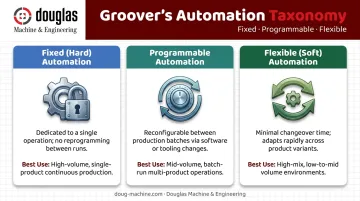
Not all automation looks the same. Groover's widely cited taxonomy identifies three distinct levels:
- Fixed (hard) automation — Equipment performs a single operation sequence at high volume with no reprogramming capability; ideal for commoditized, mass-production runs
- Programmable automation — The system can be reconfigured between product batches, making it practical for mid-volume production across part families
- Flexible (soft) automation — Equipment adapts to varied tasks with minimal changeover time, suited for high-mix environments where part configurations shift frequently
Most manufacturers don't run fully "lights-out" operations. As HBR noted, fully automated production has been realized in only a handful of facilities worldwide. The more common reality is a hybrid model — automated systems handle repetitive, precision-critical tasks while humans program, maintain, and oversee the process. The right balance depends on production volume, part complexity, and how frequently configurations change.
Key Components of an Automated Manufacturing System
Understanding what makes up an automated system helps manufacturers evaluate vendors and avoid gaps in system design. Five functional layers work together to deliver consistent, controllable output:
- Power and Actuation — the physical force behind motion
- Sensing and Feedback — real-time monitoring and correction
- Control System — the operational brain (PLCs, CNCs, HMIs)
- Programming and Decision Logic — process rules and quality thresholds
- Human-Machine Interface (HMI) and Integration — operator control and system connectivity
Power and Actuation
Motors, hydraulics, and pneumatics provide the physical force behind automated motion. These actuators translate programmed instructions into mechanical action: moving tools, positioning workpieces, and driving assembly operations.
Sensing and Feedback
Sensors, vision systems, and measurement probes monitor real-time production conditions. When a part moves out of tolerance or a process deviates from spec, the feedback layer captures the signal and routes it back to the control system for correction. Without it, deviations go undetected until a finished part fails inspection.
Control System
PLCs, CNCs, and HMIs function as the operational brain. NIST documents that integrated CAM/CNC systems can control manufacturing processes in direct response to machine and quality data — closing the loop between design intent and shop floor execution.
Programming and Decision Logic
Engineers define process logic, quality thresholds, and job recipes at this layer. High-level data models improve information flow between design and the factory floor, reducing reliance on low-level G-code and enabling more adaptive responses when conditions change mid-run.
Human-Machine Interface (HMI) and Integration
The HMI connects operators to the system — setting parameters, monitoring performance, and flagging anomalies. ISA-101 provides the lifecycle framework for HMI design in process automation environments. Beyond the operator interface, integration connects automated cells to upstream and downstream equipment and broader production workflows.
Core Benefits of Automated Manufacturing Solutions
Consistency and Quality Control
Automated systems repeat the same operation to the same specification every cycle. The Deloitte/MAPI 2019 Smart Factory Study documented one US tools manufacturer achieving a 16% reduction in defects per million after smart factory implementation. That figure reflects a single case study, not a universal average — but it shows what process consistency can deliver when automation removes human variability from high-repetition tasks.
For industries like aerospace and defense, where a single out-of-tolerance component can ground a program, this level of repeatability is a compliance requirement — not optional.
Throughput and Speed
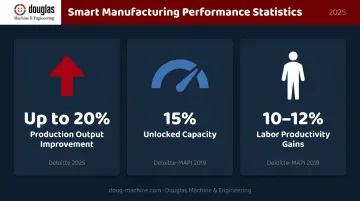
Deloitte's 2025 Smart Manufacturing Survey of 600 executives reported up to 20% improvement in production output and 15% in unlocked capacity from smart manufacturing adoption. The earlier 2019 Deloitte/MAPI study found average gains of 10–12% in production output and labor productivity from smart factory initiatives.
Automation removes manual bottlenecks and enables multi-shift or continuous production that a human workforce alone cannot sustain at the same cost or pace.
Labor Optimization
Automation reallocates workers rather than replacing them. Manufacturing systems researcher Mikell Groover notes that even highly automated factories still require humans for programming, maintenance, and plant management. That distinction matters given current labor market conditions.
Deloitte and the Manufacturing Institute project the US manufacturing sector may need 3.8 million employees between 2024 and 2033, with roughly half of those positions potentially unfilled. Automation helps manufacturers extend the output of their existing workforce — particularly for skilled trades like welding, where the American Welding Society describes the shortage as a global problem.
Cost Efficiency Over Time
The upfront cost of automated equipment is real. So is the long-term return. The Deloitte/MAPI study found that companies typically target smart-factory investments with a payback period of 2 to 3 years, driven by reduced scrap, lower rework costs, and fewer defects compounding into measurable savings over time.
Traceability and Compliance
Automated systems generate production data logs as a default output of normal operation — not as an add-on. Two certifications common in precision manufacturing set specific documentation requirements:
- ISO 9001:2015 — requires documented information supporting process operation and retained evidence that processes were carried out as planned
- AS9100D (the aerospace/defense extension) — adds production process verification records and further traceability obligations
For manufacturers pursuing or maintaining either certification, automated data capture removes the manual documentation burden and reduces audit risk.
Types of Automated Manufacturing Solutions
Robotic Welding and Fabrication
Robotic arms execute precise, repeatable weld paths across structural components, frames, and assemblies. The IFR recorded 4,281,585 industrial robots operating in factories worldwide in 2023 — up 10% year over year — with welding among the primary application categories. Aerospace structural components, heavy equipment, and automotive frames are the most common use cases.
DM&E designs, builds, and integrates custom robotic welding and assembly units tailored to specific customer workflows, including retrofitting existing systems and performing on-site validation before handoff.
CNC Machining
Computer-controlled milling, turning, and drilling produce precision components to tight tolerances across metals and composites. DM&E's CNC production shop handles components up to 20,000 lbs, with tolerances ranging from ±.005 to ±.0005 — specs that meet the demands of aerospace, defense, and precision industrial work.
That level of accuracy matters most when parts feed directly into higher-level assemblies, where a few thousandths of an inch can affect fit, function, and safety.
Automated Assembly and Inspection
Fixture-based assembly systems hold components in repeatable positions for consistent joining operations. This repeatability reduces variation across production runs and supports tighter quality control downstream.
In-line inspection — through CMM analysis, vision systems, and dimensional verification — confirms part quality without pulling production offline. DM&E performs first article inspection (FAI) per AS9102 standards and conducts CMM analysis through its Exact Metrology partnership, treating inspection as part of the production workflow rather than a final checkpoint.
Industries That Benefit Most
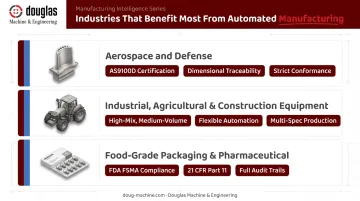
Automation delivers the most measurable returns in sectors where precision, traceability, and regulatory compliance aren't optional. Three industries stand out:
- Aerospace and defense: Components must meet strict dimensional tolerances, and every production step requires documented evidence of conformance. AS9100D certification is a baseline requirement for suppliers in this space — automated systems are the most reliable way to generate that documentation consistently.
- Industrial, agricultural, and construction equipment: These manufacturers typically operate in high-mix, medium-volume environments where flexible automation outperforms fixed lines. Shifting between part families without full retooling is a direct competitive advantage.
- Food-grade packaging and pharmaceutical: Regulatory pressure from the FDA's FSMA preventive controls framework and 21 CFR Part 11 electronic records requirements is substantial. Automated systems provide the audit trails and process consistency these regulations demand, without the error exposure that comes with manual record-keeping.
How to Choose the Right Automated Manufacturing Partner
Three questions separate competent vendors from genuine partners:
1. Do they offer end-to-end capability?
A partner who handles design, fabrication, machining, finishing, and installation under one roof eliminates the coordination risk that comes with splitting a program across multiple vendors. DM&E covers this entire range in-house — from concept and CNC machining through welding, project management, and supplier coordination for outsourced processes like heat treatment and plating — keeping quality accountability in a single place.
2. Do they hold the right certifications?
DM&E holds the full stack of credentials for precision contract manufacturing:
- ISO 9001:2015 — documented process control across commercial manufacturing
- AS9100D — aerospace and defense-specific requirements
- AWS-certified welders — structural fabrication assurance
- CAGE Code 87BF4 with SAM/JCP approvals for government-adjacent programs
3. How do they handle problems?
Every project encounters schedule pressure or scope questions. The difference is whether your partner communicates proactively or goes quiet. DM&E operates on an open-door policy: when issues arise, the expectation is direct, timely communication — not damage control after the fact.
Frequently Asked Questions
What are automated manufacturing systems?
Automated manufacturing systems combine machinery, sensors, and control software to perform production tasks — machining, welding, assembly, inspection — with minimal human intervention. They're built to improve speed, precision, and consistency across high-volume or precision-critical environments.
What are some examples of automated manufacturing?
Common examples include CNC machining centers, robotic welding cells, automated assembly lines, in-line inspection systems, and conveyor-based packaging equipment. These appear across aerospace structural fabrication, food-grade packaging, and pharmaceutical production — anywhere precision and throughput both matter.
What are the 5 basic components of an automated system?
Every automated system is built around five core components:
- Power source and actuators
- Sensors and feedback devices
- Control system (PLC or CNC)
- Programming and decision-making interface
- Human-machine interface (HMI) for operator interaction
Are there any completely automated factories?
Fully lights-out factories exist in select industries — semiconductor fabrication and automotive stamping are the clearest examples — but they're uncommon. Most manufacturers run hybrid environments where humans program, maintain, and oversee automated systems.
What industries benefit most from automated manufacturing?
Aerospace, defense, automotive, food and beverage packaging, pharmaceutical, and industrial equipment manufacturing see the strongest returns — sectors where precision, throughput, and regulatory compliance all apply simultaneously and failure tolerance is low.