Key Takeaways
- Aerospace fabrication demands tolerances as tight as ±0.0005 inches — errors cascade into program delays and safety hazards
- AS9100D and ISO 9001:2015 certifications are baseline requirements, not differentiators
- CNC machining, precision welding, and investment casting remain the core production methods; additive manufacturing is earning flight-certified approvals at an accelerating pace
- Full material traceability — mill cert to finished part — is non-negotiable at every tier of the supply chain
- A single-source fabrication partner consolidates quality accountability, eliminates fragmented POs, and protects program schedules
What Is Aerospace Fabrication and Why It Matters
Aerospace fabrication covers the full process of designing, cutting, forming, joining, and finishing metal and composite components used in aircraft, spacecraft, and defense systems. It differs from general metal fabrication in ways that matter at every stage of production:
- Tighter tolerances — dimensional accuracy requirements measured in thousandths of an inch, not fractions
- Continuous regulatory oversight — AS9100D, NADCAP, and FAA/EASA compliance requirements apply throughout production, not just at final inspection
- Higher failure consequences — a defective fastener or weld doesn't just mean a return; it can ground a fleet or delay a program by months
When a component fails a quality check, the fallout rarely stays contained. GAO reporting on the Wideband Global SATCOM program documented 1,500 incorrectly installed fasteners on each of the first three satellites, resulting in $10M in rework costs and an 18-month delay to initial operating capability. That's a single supplier error cascading into a program-level disaster.
The market reflects how seriously the industry takes this. According to The Business Research Company's 2026 aerospace parts manufacturing report, the global aerospace parts manufacturing market is estimated at $1.02 trillion in 2025, projected to reach $1.29 trillion by 2030 at a 4.6% CAGR. At that scale, aerospace OEMs can't afford to qualify a new supplier mid-program — which is why certifications like AS9100D function as the baseline requirement for getting on a bid list, not a differentiator.
Key Aerospace Fabrication Techniques
CNC Machining
CNC machining is the production backbone for most structural and engine aerospace components. Multi-axis milling and turning allow manufacturers to cut complex geometries — turbine blades, bulkheads, engine mounts — while maintaining the tight tolerances flight hardware demands.
NASA's JSC-67701 fabrication standards document defines precision hole diametral tolerance as not exceeding .002 inches, with machined surface squareness held within .002 in/in. In practice, shops serving aerospace programs routinely work within even tighter bands. DM&E's CNC machining capability achieves tolerances ranging from ±0.005 to ±0.0005 inches, handling components up to 20,000 lbs.
Five-axis machining matters here for a specific reason: complex aerospace geometries like blisks (blade-integrated disks) and airfoils require angled tool access that would otherwise demand multiple setups and refixturing.
Each setup change introduces the possibility of datum shift — exactly the kind of error aerospace tolerances don't forgive.
Precision Welding
Aerospace welding is governed by AWS D17.1/D17.1M, the specification covering fusion welding for aerospace flight and non-flight hardware. When contract documents invoke it, compliance is mandatory — not optional.
The standard covers aluminum, nickel, titanium, cobalt, and magnesium alloy families. For titanium welding specifically, NASA MSFC-SPEC-3679 requires argon or helium shielding and color-based weld acceptance criteria per AWS G2.4/G2.4M — measures that prevent contamination-related embrittlement.
DM&E maintains AWS-certified welders on staff, a requirement that carries real weight in aerospace procurement. Weld quality in this context isn't about aesthetics — it's about full traceability from welder qualification through inspection documentation.
Sheet Metal Fabrication, Casting, and Forging
Sheet metal processes — forming, bending, punching, and laser cutting — produce airframe panels, enclosures, and structural brackets. Fiber laser cutting improves edge quality and reduces the secondary finishing operations that add time and cost.
For complex near-net-shape components, investment casting and closed-die forging remain the methods of choice:
- Investment casting enables intricate internal geometries, used extensively for turbine components. At extreme operating temperatures (combustion gas streams reaching 3,000°F), grain boundary control in cast components directly determines fatigue and creep life — single-crystal turbine airfoils can achieve up to nine times the creep and thermal fatigue resistance of multi-grain equivalents.
- Closed-die forging optimizes grain flow for maximum strength and toughness, applied to turbine disks, landing gear components, and structural brackets. The aircraft closed-die forging market is estimated at $18B in 2024, projected to reach $24.8B by 2032.
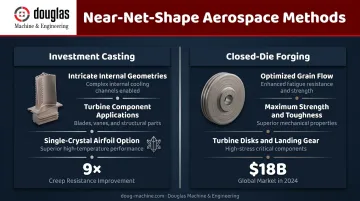
DM&E coordinates casting and forging through its qualified supplier network as part of program management — maintaining quality oversight and single-point accountability without requiring customers to manage those supplier relationships directly.
Composite Manufacturing
Composites now define structural design at the top of commercial aviation. Boeing states the 787 airframe is 50% carbon fiber reinforced plastic and other composites; Airbus reports the A350 uses 53% composites and 14% titanium.
These figures mean fabricators serving commercial aerospace programs must integrate metallic and composite supply chains — not treat them as separate disciplines.
Composite machining introduces challenges absent from metal cutting. Key considerations include:
- Tool wear: Accelerates rapidly compared to most metal applications, requiring tighter monitoring intervals
- Delamination risk: Hole margins are particularly vulnerable; CFRP drilling research uses 0.4mm flank wear on diamond-coated carbide drills as the end-of-life criterion
- Process discipline: Unlike metal cutting, there is limited margin for rework once delamination occurs
Materials at the Heart of Aerospace Components
Material selection determines which fabrication techniques are viable and which quality controls are required. Three metallic families dominate:
| Material | Typical Applications | Why It's Used |
|---|---|---|
| Aluminum alloys (2xxx, 7xxx series) | Fuselage panels, structural frames | Lightweight, high toughness and fatigue resistance |
| Titanium (Ti-6Al-4V) | Engine components, airframe fittings | Best strength-to-weight ratio, corrosion resistant |
| Nickel superalloys (Waspaloy, Alloy 718) | Turbine blades, vanes, disks | Retains strength above 1,000°F |
Carbon fiber reinforced polymers (CFRP) increasingly complement these metals in weight-critical structures — but they introduce tool wear and delamination risks that require specialized cutting parameters and tooling strategies.
Material traceability is a documented requirement, not a best practice. Boeing's supplier quality requirements (D6-87282 Rev F) mandate that quality records traceable to supplied products be maintained for at least 10 years after shipment, with documented chain of custody traceable to the original mill producer.
Every heat/lot certification must follow the material from raw stock through finished part. Aerospace customers audit for this — and gaps in the chain of custody can disqualify a supplier regardless of part quality.
Quality Standards That Define Aerospace Manufacturing
AS9100D and ISO 9001:2015
AS9100D is the aerospace-specific quality management standard built on ISO 9001:2015. It adds requirements for risk management, configuration control, first article inspection, and supplier oversight that general manufacturing standards don't address.
Holding both certifications signals documented processes, continuous improvement, and consistent output across production runs. Approximately 27,600 AS9100-series certifications exist worldwide — making certification necessary but not sufficient on its own.
What separates compliant shops from merely certified ones is how those standards are applied in practice. DM&E holds both AS9100D and ISO 9001:2015 certifications, along with AWS-certified welders and CAGE Code 87BF4 — a combination that satisfies aerospace and defense program requirements, including federal contracting eligibility through SAM and JCP approval.
First Article Inspection and In-Process Verification
Those certifications carry real weight at the inspection stage. SAE AS9102 establishes documentation requirements for First Article Inspection (FAI) — the quality gate that validates a new production process before full-rate production begins. FAI is required any time a change to manufacturing source, process, or inspection method could affect fit, form, or function.
DM&E delivers FAI reporting per AS9102, supported by:
- CMM dimensional verification via Exact Metrology, capable of validating tolerances to 0.0001 inches
- Dimensional verification on certified granite tables and gauges
- Comprehensive quality documentation packages for aerospace and defense compliance
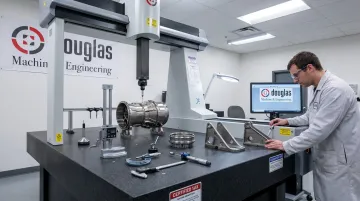
Non-destructive testing (NDT) catches subsurface defects that visual inspection misses. Liquid penetrant per ASTM E1417 and magnetic particle per ASTM E1444 are both supported — with DM&E coordinating any out-of-house NDT through its qualified supplier network.
Innovation and Technology Trends in Aerospace Fabrication
Additive Manufacturing
Metal additive manufacturing (AM) has moved past the prototype stage into certified production. GE Aviation's most cited example: 30,000 3D-printed LEAP fuel nozzle tips produced by 2018, consolidating a 20-part assembly into a single component with approximately 25% weight reduction. The FAA issued AC 33.15-3 in June 2023 specifically covering powder bed fusion AM for aircraft engine parts — regulatory recognition that this process is production-ready when controlled correctly.
The broader AM industry exceeded $20B in 2024, with metal AM growing 24.4% year-over-year. Aerospace remains one of the highest-growth segments driving that expansion.
Digital Twins and Model-Based Definition
NASA defines a digital twin as an integrated multiphysics, probabilistic simulation of an as-built vehicle using physical models, sensor updates, and fleet history data. For fabrication, this means manufacturers can simulate stress, thermal behavior, and fatigue before cutting a single piece of metal — compressing prototype cycles and surfacing design-for-manufacturing issues early.
Model-Based Definition (MBD) ties directly into this workflow. Lockheed Martin's 2026 Supplier MBE Playbook identifies the digital thread as a critical capability underlying digital twin technology. MBD packages built to ASME Y14.41 carry all manufacturing and inspection data within the 3D model, reducing drawing errors and tightening design-to-production integration.
Robotics and Automation
Aerospace shops competing on repeatability and capacity now rely on a core set of automation capabilities:
- Robotic welding cells — consistent weld quality across high-volume production runs
- Automated deburring systems — NIST research describes cells that generate robot paths directly from part geometry, removing a labor-intensive finishing step
- Lights-out CNC machining — unattended operation that expands throughput without adding headcount
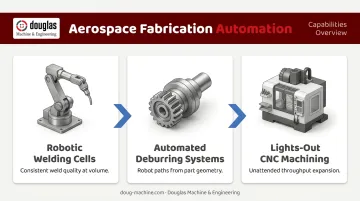
DM&E has built custom robotic welding and assembly systems into its production workflow — applying these same principles to deliver higher throughput for aerospace and defense programs.
What to Look for in an Aerospace Fabrication Partner
Every credible aerospace fabrication partner clears the same baseline bar: AS9100D and ISO 9001:2015 certification, AWS-certified welders for structural and safety-critical assemblies, and a CAGE Code for any defense program work — the five-character DLA identifier that enables federal contracting eligibility.
Credentials get you in the door. What separates reliable partners from the rest comes down to three operational factors:
- Single-source accountability: One partner managing CNC machining, welding, fabrication, finishing, and supplier coordination eliminates fragmented purchase orders and keeps quality accountability in one place. DM&E's "Precision Manufacturing from Concept to Installation" model does exactly this — including oversight of outsourced processes like heat treatment and plating through qualified supplier partners.
- Front-end engineering capability: Partners who engage at the concept stage catch manufacturability issues before they become rework costs. DM&E works in PTC Creo, CATIA v5, and AutoCAD to support early design collaboration.
- Communication transparency: Delays in aerospace supply chains cascade into program overruns. Partners with open-door policies and proactive issue resolution — DM&E maintains this as a core value — protect schedules before problems escalate.
Frequently Asked Questions
What does an aerospace fabricator do?
An aerospace fabricator designs, machines, welds, and finishes precision components for aircraft, spacecraft, and defense systems. They work to strict dimensional tolerances and comply with quality standards like AS9100D, maintaining full documentation traceability from raw material to delivered part.
What certifications should an aerospace fabricator have?
AS9100D and ISO 9001:2015 are the primary quality certifications. AWS-certified welders are required for structural and flight-hardware welding, and a CAGE Code is essential for defense program eligibility. Some programs also require NADCAP accreditation for special processes.
How is aerospace fabrication different from standard metal fabrication?
Aerospace fabrication requires tighter tolerances, aerospace-grade alloys, full material traceability, regulatory-compliant inspection documentation, and certified quality management systems. Standard commercial fabrication carries none of those requirements.
What materials are most commonly used in aerospace fabrication?
The primary material families — chosen for strength-to-weight ratio, fatigue resistance, and performance at temperature extremes — are:
- Aluminum alloys
- Titanium alloys (especially Ti-6Al-4V)
- Nickel superalloys
- Carbon fiber reinforced polymers (CFRP)
How does CNC machining support aerospace component quality?
Multi-axis CNC machining achieves tight tolerances, ensures repeatability across production runs, and generates digital process records that support traceability. Tolerance bands of ±0.0005 inches are achievable on properly equipped equipment.
What role does innovation play in modern aerospace fabrication?
Additive manufacturing enables complex geometries and part consolidation. Digital twins compress prototype iterations by simulating component behavior before production begins. Robotic automation improves consistency and throughput.