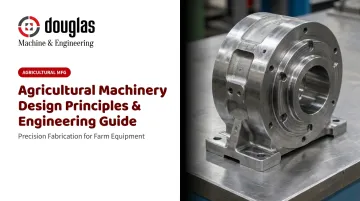
This guide covers the engineering principles behind agricultural machinery design: how machinery categories map to specific mechanical loads, how structural and material decisions are made, why manufacturing precision directly affects field performance, and where smart technology is pushing design requirements forward.
Key Takeaways
- Soil forces, seed-spacing accuracy, and fatigue cycles — not just basic functionality — define agricultural machinery design requirements
- Steel grade selection, bearing specifications, and weld quality are performance variables, not commodity decisions
- Tight CNC tolerances on seed metering discs, drive shafts, and bearing seats translate directly to operational consistency
- Precision farming and autonomous equipment demand tighter component tolerances and faster design-to-production cycles than conventional ag machinery
Types of Agricultural Machinery and Their Engineering Functions
Every machinery category is defined by the mechanical forces it must manage. A tillage implement deals with soil compression and shear. A planter deals with timing and dimensional precision. A combine harvester deals with cyclic fatigue and throughput. Understanding those distinctions shapes every design decision, from cross-section geometry to bearing selection.
Tillage and Seeding Equipment
Tillage implements — ploughs, subsoilers, cultivators, strip-till aggregates — must resist substantial lateral and vertical soil forces. USDA-ARS research measured subsoiler draft forces ranging from 5.85 kN in sandy loam to 13.14 kN in clay loam at 0.33 m working depth. Frame members and shanks are engineered with specific cross-sections to handle that bending stress without deflection across repeated field passes. A shank that deflects under load changes working depth, directly affecting yield outcomes.
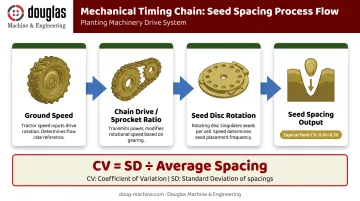
Planting machinery introduces a distinct challenge: mechanical timing. Seed spacing accuracy depends on the relationship between ground speed, seed disc rotation, and furrow depth. Sprocket tooth counts, chain pitch, and disc hole geometry are calculated to achieve consistent seed placement. John Deere defines seed-spacing coefficient of variation (CV = standard deviation ÷ average spacing), with typical field CV of 0.10–0.30. That number is directly traceable to bearing fits, sprocket alignment, and metering disc tolerances.
Harvesting, Irrigation, and Fluid-Handling Equipment
Combine harvesters and threshers combine multiple simultaneous mechanical operations: reaping, threshing, and winnowing, all within one chassis under continuous load. Fatigue analysis across the full operating spectrum is essential here, not just peak load conditions, because rotor imbalance, belt tension variation, and accumulated chain wear all drive stress at frame joints over time.
Irrigation systems involve hydraulic engineering: pump sizing, pipe pressure ratings, and flow calculations scaled to field area and crop water demand.
Boom sprayers and manure spreaders add a structural dimension. Tank weight when full, nozzle pressure uniformity, and frame deflection under liquid payload all require calculated design rather than rule-of-thumb sizing.
Key Engineering Principles Behind Agricultural Machinery Design
Good design starts with real operating conditions — load cycles, terrain variability, duty hours — before any material is selected or component sized.
Structural Load Analysis and Safety Factors
Designers calculate static and dynamic loads on primary structural members: frames, axles, hitches, drawbars. A Factor of Safety (FOS) is applied to ensure components survive not just expected loads but peak stress events — transport shock, hard-ground impacts, and overload conditions.
The FOS is not a universal value. It's derived from the specific load case, material properties, weld classification, and fatigue spectrum. An ASABE study on PTO gear design for a 105 hp agricultural tractor confirmed that equivalent torque during rotary tillage exceeded average torque — meaning peak loads routinely outrun rated conditions. Designers must account for that variability, not design to a nominal load only.
Power Transmission and Drive System Design
Power moves from the engine or PTO through chain drives, gear systems, belts, or hydraulic circuits. ANSI/ASABE AD500-1 standardizes rear PTO interfaces at 540 r/min (Type 1) and 1000 r/min, with overspeed controls preventing the 540 r/min shaft from exceeding 630 r/min. Drive system design must balance torque delivery, speed ratios, and wear resistance within those interface constraints.
Sprocket tooth count and chain pitch control output RPM and chain life. In agricultural conditions — dust, mud, crop residue, shock loading — chain wear accelerates significantly compared to clean industrial environments. SKF's agricultural solutions data confirms that automatic lubrication and proper seal selection can extend chain service life substantially in these conditions.
Fatigue, Stress Concentration, and Tolerance in Moving Parts
Cyclic loading is the defining failure mode in agricultural equipment. Every field pass, every shaft revolution, every conveyor cycle adds to cumulative fatigue at stress concentration points — weld toes, shaft shoulders, bolt holes, and frame junctions. Designers address this by specifying fillet radii at transitions, avoiding abrupt section changes, and reinforcing high-stress geometry.
Precision in moving parts carries equal weight. Tolerance errors in key components translate directly to field performance problems:
- Seed metering discs: Excessive clearance produces skip-and-double seed events visible in yield data
- Thresher rotors: Insufficient clearance causes binding, heat buildup, and accelerated wear
- Planter drives: Dimensional drift across multiple row units compounds into inconsistent plant populations
Machining accuracy isn't a manufacturing detail — it's a performance variable with measurable consequences.
Operator Safety and Ergonomics
OSHA 29 CFR 1928.57 establishes guarding requirements for moving parts on farm field equipment. ANSI/ASABE S318.19 covers broader safety scope for agricultural field equipment operation and servicing. Design compliance means meeting each of these baseline requirements — none are optional additions:
- Guarded PTO shafts meeting OSHA clearance specifications
- Balanced machine weight distribution to prevent tip hazards
- Controlled hitch loads within drawbar rating limits
- Clear operator clearance zones around all moving components
Materials and Structural Considerations in Farm Equipment Design
Material selection follows a simple rule: separate structural strength requirements from wear requirements from corrosion requirements. Trying to solve all three with one steel specification leads to poor outcomes in at least two categories.
Steel Grades and Bearing Selection
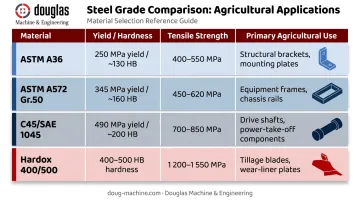
| Material | Key Properties | Primary Use |
|---|---|---|
| ASTM A36 | ~250 MPa yield, 400–550 MPa tensile | Guards, brackets, non-wear structures |
| ASTM A572 Grade 50 | ~345 MPa yield, 450 MPa min tensile | Higher-strength frames, weight-sensitive members |
| C45 / SAE 1045 | 490 MPa proof stress, 700–850 MPa tensile (QT, <16mm) | Shafts, pins, hubs, drive components |
| Hardox 400/500 | 400/500 HBW nominal hardness | Tillage points, scraper blades, wear liners |
Bearing selection works the same way. ISO 281:2007 defines rolling bearing rating life at 90% reliability, and L10 life calculations should align with the machine's expected service intervals. Agricultural environments demand sealed or shielded bearings — SKF's agricultural hub specifications explicitly target mud, dust, water, fiber, and high-pressure wash conditions. A bearing rated for factory conditions will fail prematurely in the field without proper sealing and lubrication retention.
Surface Protection and Weld Quality
Fertilizer and pesticide exposure degrades coatings that perform well in standard testing. The American Galvanizers Association notes that ASTM B117 salt spray results rarely correlate with natural environment performance when used alone. Base coating selection on application-specific chemical exposure data and OEM specs — not generic salt-spray hour claims. Common options each suit different exposure profiles:
- Powder coat: Good for mechanical abrasion resistance; less effective against strong chemical exposure without primer
- Hot-dip galvanizing: Suited for high-moisture, high-corrosion environments; check compatibility with fertilizer chemistry
- Phosphate pretreatment: Typically used as a primer system beneath topcoats, not as a standalone barrier
Welded joints are primary load paths. Weld quality — penetration depth, bead geometry, heat-affected zone characteristics — directly affects fatigue strength at frame junctions, hitch points, and boom connections. AWS D1.1/D1.1M covers structural welding requirements for steel fabrication.
AWS-certified welding procedures and documented inspection protocols define the difference between a joint that meets rated load capacity and one that fails at first season stress.
Designing for Durability, Safety, and Serviceability
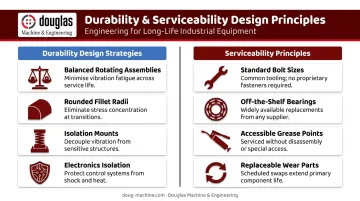
The most durable farm equipment is designed with maintenance in mind before the first weld is made. Components that wear — bearings, belts, blades, seals — should be positioned for field access without disassembling major assemblies.
Design strategies that extend service life:
- Balanced rotating assemblies to reduce vibration-induced fatigue at weld joints
- Rounded fillet radii at all stress concentration points (shaft shoulders, frame junctions)
- Isolation mounts for high-frequency components to protect adjacent structure
- Isolation of electronics and sensors from direct vibration paths
Serviceability design principles that reduce downtime:
- Standard bolt sizes across the machine (reduces tool requirements)
- Off-the-shelf bearings with common bore sizes
- Accessible grease points that don't require component removal
- Replaceable wear parts positioned at the periphery, not buried in the drivetrain
Even the best design principles only hold up if validated under real conditions. Prototype testing in actual field environments — not on a bench — catches failures that lab settings routinely miss: stress cracking at weld joints, seal failures under soil pressure, and drivetrain inefficiencies that surface only at full load.
Repeated field testing across variable soil and crop conditions drives the final refinements needed before production.
How Precision Manufacturing Impacts Agricultural Machinery Quality
A well-engineered design is only as good as its manufacturing execution. Dimensional tolerances that slip during production create misaligned drives, accelerated bearing wear, inconsistent seed placement, and field failures that trace back to the shop floor, not the design office.
CNC Machining and Component Accuracy
CNC machining enables the tight tolerances required for seed metering discs, drive shafts, gear housings, and bearing seats , where fit and alignment directly determine operational consistency. Modern CNC production capabilities allow complex agricultural components to be produced with high part-to-part repeatability across production runs, eliminating the dimensional variation that causes premature wear in the field.
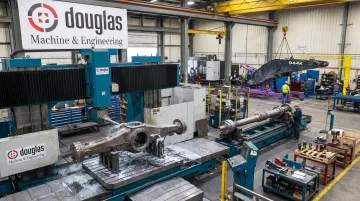
DM&E's ISO 9001:2015-certified CNC production shop machines components up to 20,000 lbs with tolerances ranging from ±0.005 to ±0.0005 inches. Using PTC Creo, CATIA v5, and AutoCAD, their engineering team can take a customer concept through design, CNC programming, machining, and fabrication within a single managed workflow — eliminating the handoff errors that introduce tolerance stack-up when multiple vendors are involved. For agricultural OEMs, that single-workflow capability means fewer coordination variables and tighter control over final component accuracy.
Quality Standards and Consolidated Manufacturing
ISO 9001:2015 ensures systematic quality management from design review through final inspection — version-controlled drawings, documented inspection protocols, first article inspection, non-conformance handling, and record retention. For agricultural OEMs managing warranty liability, certified manufacturers provide the documentation trail that supports both customer accountability and supply chain auditing.
DM&E carries both ISO 9001:2015 and AS9100D certifications. AS9100D was developed for aerospace, where traceability and process control requirements rank among the most rigorous in manufacturing.
Applied to agricultural components, that means documented inspection records, first article reporting per AS9102, and change control processes equivalent to what aerospace customers require — a concrete quality floor for precision agricultural work.
Those same certification standards make the case for consolidated manufacturing. When machining, welding, fabrication, and powder coating happen within one managed operation, a single entity owns quality accountability at every step. DM&E integrates these capabilities in-house:
- CNC machining to tight dimensional tolerances
- AWS-certified structural fabrication (up to 20 tons)
- In-house thermoset powder coating
Heat treat and plating are coordinated through qualified suppliers under DM&E's project management, keeping the accountability chain intact rather than distributing it across unconnected vendors.
Emerging Technologies Shaping Agricultural Machinery Design
Modern agricultural machinery increasingly must accommodate technology integration as a baseline design requirement, not a retrofit. Grand View Research values the precision farming market at $11.67 billion in 2024, projected to reach $24.09 billion by 2030. The autonomous farm equipment market reached $12.45 billion in 2023. Both figures reflect how thoroughly these technologies have moved into the mechanical design process itself.
That shift has direct consequences for how machines are built. GPS guidance systems, variable rate technology, and IoT sensors require more precise mechanical assemblies, sealed electronics housings, and designed-in mounting provisions. GNSS brackets, sensor mounts, and actuator interfaces belong in the original design spec — not added in the field after the fact.
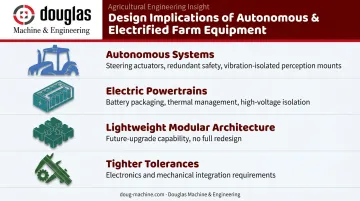
Design implications of autonomy and electrification:
- Autonomous systems (self-steering tractors, robotic harvesters) require high-duty steering actuators, redundant safety architecture, and perception hardware mounts engineered for vibration isolation
- Electric and hybrid powertrains (including AGCO's Fendt e100 Vario and New Holland's T4 Electric Power) shift design attention to battery packaging, thermal management, and high-voltage isolation from structural steel
- Lighter-weight materials and modular architectures support future technology upgrades without requiring a full redesign
- Tighter manufacturing tolerances are a direct requirement when electronics and mechanical systems share the same assembly
Frequently Asked Questions
What types of machines are used in agriculture?
The main categories are tillage equipment (plows, cultivators, subsoilers), planting machinery (seed drills, precision planters), harvesting equipment (combine harvesters, threshers), irrigation systems, and spraying equipment. Tractors power most of these implements through PTO and hydraulic connections.
What materials are most commonly used in agricultural machinery design?
Structural frames use mild or HSLA steels (ASTM A36, A572 Grade 50), while drive shafts use C45/SAE 1045 medium carbon steel. High-wear surfaces like tillage points rely on abrasion-resistant grades such as Hardox 400 or 500. Exposed components require powder coating or hot-dip galvanizing for corrosion protection.
What engineering calculations are critical when designing agricultural machinery?
Essential calculations cover several interdependent areas:
- Bending and torsion stress analysis on frames and shafts
- Factor of Safety selection against load spectrum and material allowables
- Chain/sprocket ratios and bearing L10 life calculations
- Hydraulic flow and pressure sizing for irrigation and spraying systems
How does precision machining affect agricultural machinery performance?
Tight CNC tolerances ensure proper fit and alignment of seed metering discs, drive shafts, and bearing seats. Dimensional accuracy at these interfaces reduces wear rates and maintains consistent seed spacing. Even small tolerance errors translate directly into yield loss and reliability failures in the field.
What design features most improve the durability of farm equipment?
Several design decisions have the most direct impact on service life:
- AWS-certified weld quality on reinforced frame joints
- Sealed bearings rated for agricultural contamination levels
- Fatigue-resistant geometry with rounded fillets at stress concentrations
- Serviceability-oriented layout that enables fast field maintenance
What certifications should I look for in an agricultural machinery manufacturer?
ISO 9001:2015 ensures systematic quality management with documented traceability from design through delivery. AWS certification confirms weld integrity on structural fabrications. AS9100D signals rigorous process control, first article inspection, and traceability disciplines — standards that transfer directly to precision agricultural component manufacturing.